
Six Years, Three CEOs, Eleven Managers, One Product Still Running.
How I grew from a solo designer to a senior design leader — six years building an enterprise shop floor platform for two of the most demanding industries in the world.
My Role
- UX Design Lead
Duration
- Multiple Years
Collaborators
- Product Managers
- Engineering Teams
- UX Designers
- Users
Skills Used
- Design Leadership
- Ethnographic Research
- Listening
- Problem-Solving
- Whiteboarding
- Wireframing
- Prototyping
- Usability Studies
The Problem
Two Industries. Dozens of Shops. All Running on Paper.
GE Aviation repairs the jet engine components that keep commercial aircraft flying. GE Power — now GE Vernova — repairs the gas turbine components that keep power plants running around the world. Both operate global networks of component repair shops. And in 2016, both were running entirely on paper.
Every repair job was tracked through a physical packet — a document called a router. It told technicians which parts to work on, which operations to complete, and what quality checks were required before a component could move forward. It was covered in handwritten notes, colored stamps, and signatures from inspectors who may or may not still be on shift.
Before — The Paper Router
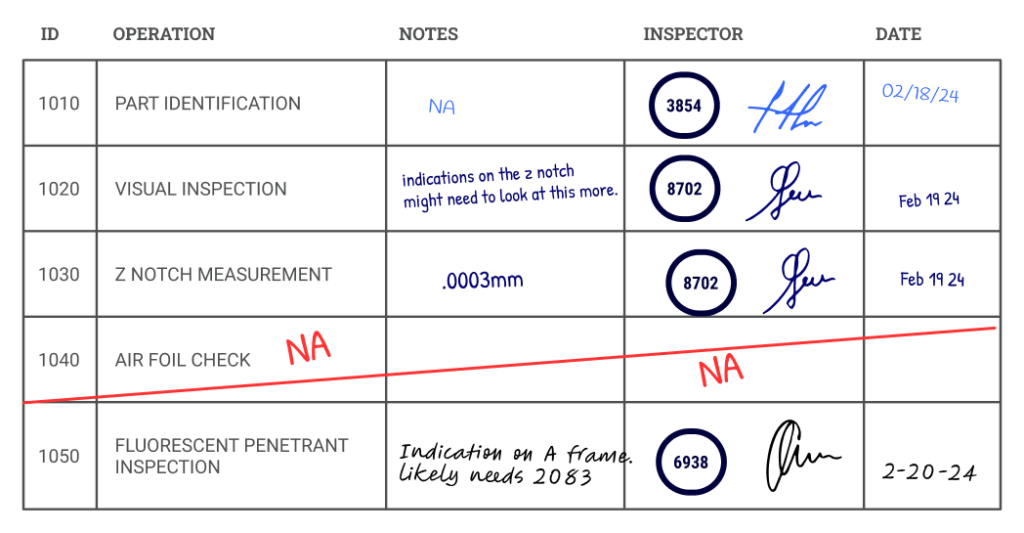
The business problems were significant: no real-time visibility into shop floor status, no data for design engineers or customers, no way to identify bottlenecks across a global network, and compliance documentation that could physically disappear. But the human problem was just as real — technicians were spending hours every day navigating a system that was never designed to scale.
The design challenge: Build a single digital platform that could replace paper-based repair execution across two different industries, eight shops, and dozens of cells,each with its own vocabulary, processes, and culture, without alienating the technicians who depended on those processes every day.
The Approach
Research First, Always. Even When the Org Was on Fire.
I joined the project in May 2016 as the sole designer, embedded with GE Power’s Brilliant Repair Services team in Greenville, South Carolina. The mandate was clear: digitize the shop floor. What wasn’t clear was how radically different every shop’s process would turn out to be once we started looking.
Before any design work began, I traveled to component repair facilities to conduct ethnographic research — observing technicians, asking questions, and mapping actual workflows rather than the ones people described in conference rooms. What we found was a patchwork of local adaptations built up over decades of acquisitions. Same job, different vocabulary. Same part, different sequence. Same role, different name.
Research principle we never abandoned: No design decision gets made without shop floor evidence. Not once in six years did we ship something we hadn’t tested with real technicians in real environments.
In 2017, GE Digital brought GE Aviation into the project, transforming SmartShop from a Power-only tool into a joint venture platform serving two industries simultaneously. That’s when the complexity multiplied — and when I went from solo designer to leading a team.
Over the following years, I built and led a distributed UX team that grew from just me to four designers across the US and Europe, eventually reaching seven at peak. We ran on a two-week sprint schedule, maintained design critiques aligned with shared product principles, and created a series, ShopTalk, that delivered shop-floor insights directly to engineering teams who couldn’t make on-site trips.
When we lost our development team in Hungary and rebuilt with a team in Poland, the design system and documented processes we’d built meant we could onboard new engineers without starting from scratch. That investment paid for itself immediately.
The Key Decision
Leading Through Instability
The hardest thing about SmartShop wasn’t the design problems. It was keeping a coherent design vision alive through six years of organizational turbulence that would have killed most products.
May 2016
Solo designer, GE Power — Joined as the only designer on Brilliant Repair Services. Building from zero.
May 2017
GE Digital brings in GE Aviation — SmartShop becomes a joint venture platform serving both Power and Aviation. Scope doubles overnight. I move from GE Power to GE Digital as UX Lead.
Aug 2017
CEO change #1 — Jeff Immelt retires. John Flannery takes over as GE CEO.
Oct 2018
CEO change #2 — Flannery ousted after 14 months. Larry Culp becomes the first outside CEO in GE’s 126-year history. GE Digital is restructured — no longer a standalone unit. SmartShop moves under GE Aviation.
2018–20
Eleven managers. Constant turbulence. Funding threatened multiple times. Dev team in Hungary disbanded, rebuilt in Poland. GE Power forks the SmartShop codebase to continue independently.
Early 2020
CEO change #3 — COVID devastates GE Aviation. Culp restructures the division. SmartShop funding cut. Aviation discontinues the product.
May 2021
I move on — join GE Aerospace’s External Presence team as Sr. Staff Experience Architect.
Today
GE Vernova still running SmartShop — the Power fork is live across their global network of repair facilities.
Eleven managers in six years means eleven different people with different priorities, different communication styles, and different levels of understanding about what UX actually does. Three CEO transitions — each representing a shift in GE’s overall strategic direction — meant the product could have been descoped, redirected, or cancelled at any one of those inflection points.
The fact that GE Power forked the code rather than abandoning it — and that the fork is still running years later — is the clearest evidence that the foundation we built was solid enough to outlast the org chart.
The Solution
A Full-Stack Shop Floor Platform — Built to Last
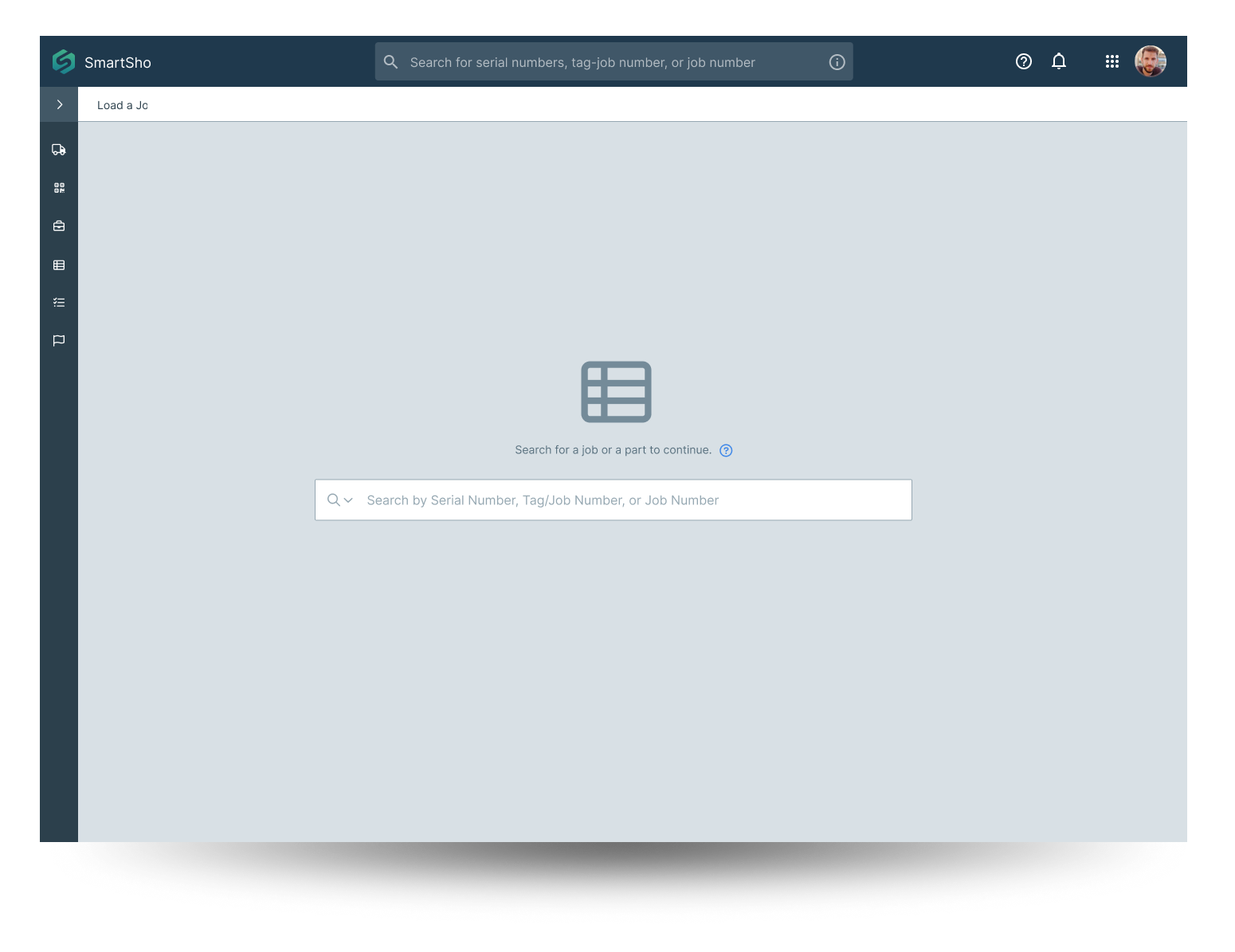
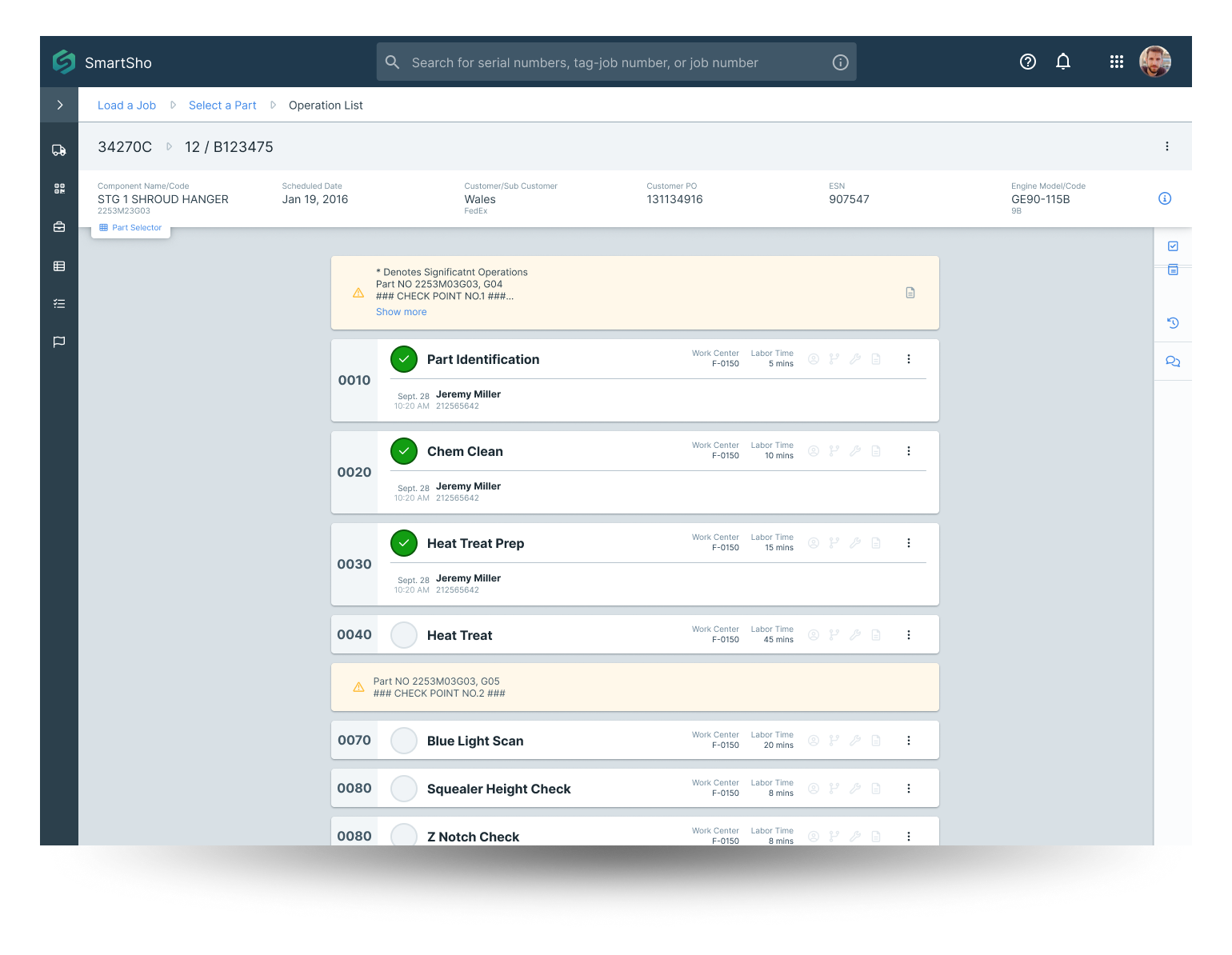
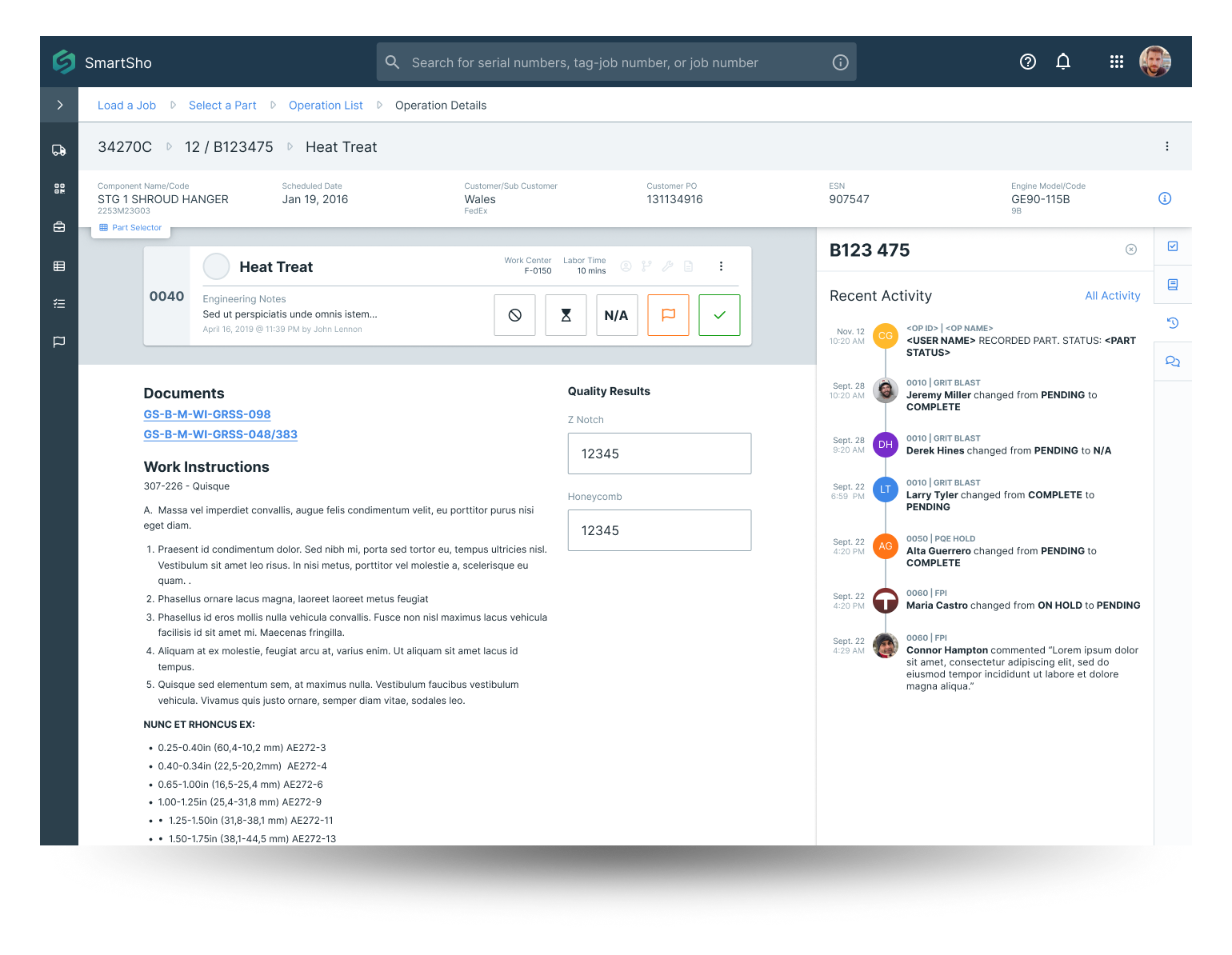
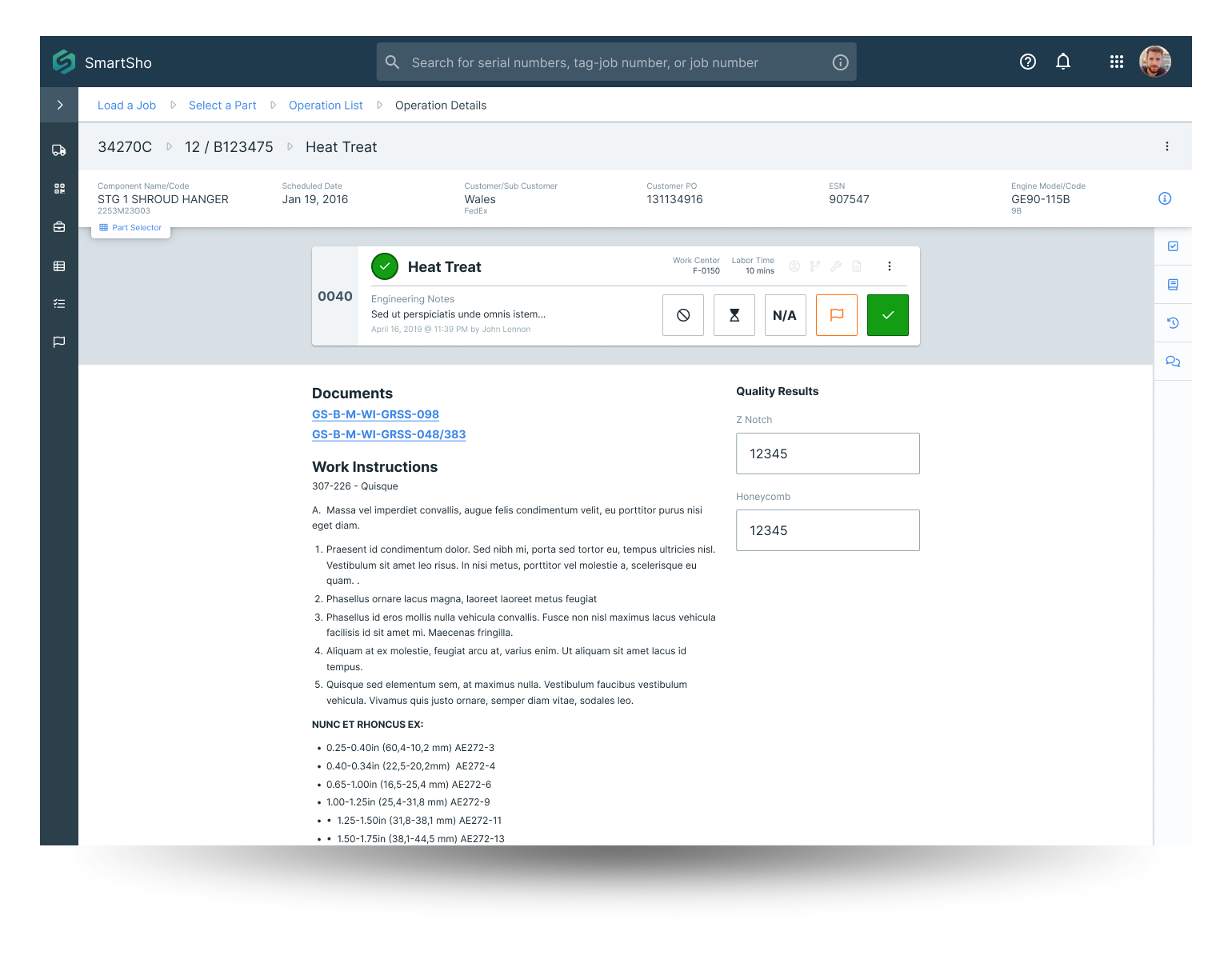
SmartShop wasn’t a single feature. It was a complete platform covering every stage of the component repair lifecycle, from the moment a job arrived at the shop to the moment a part shipped back to the customer.
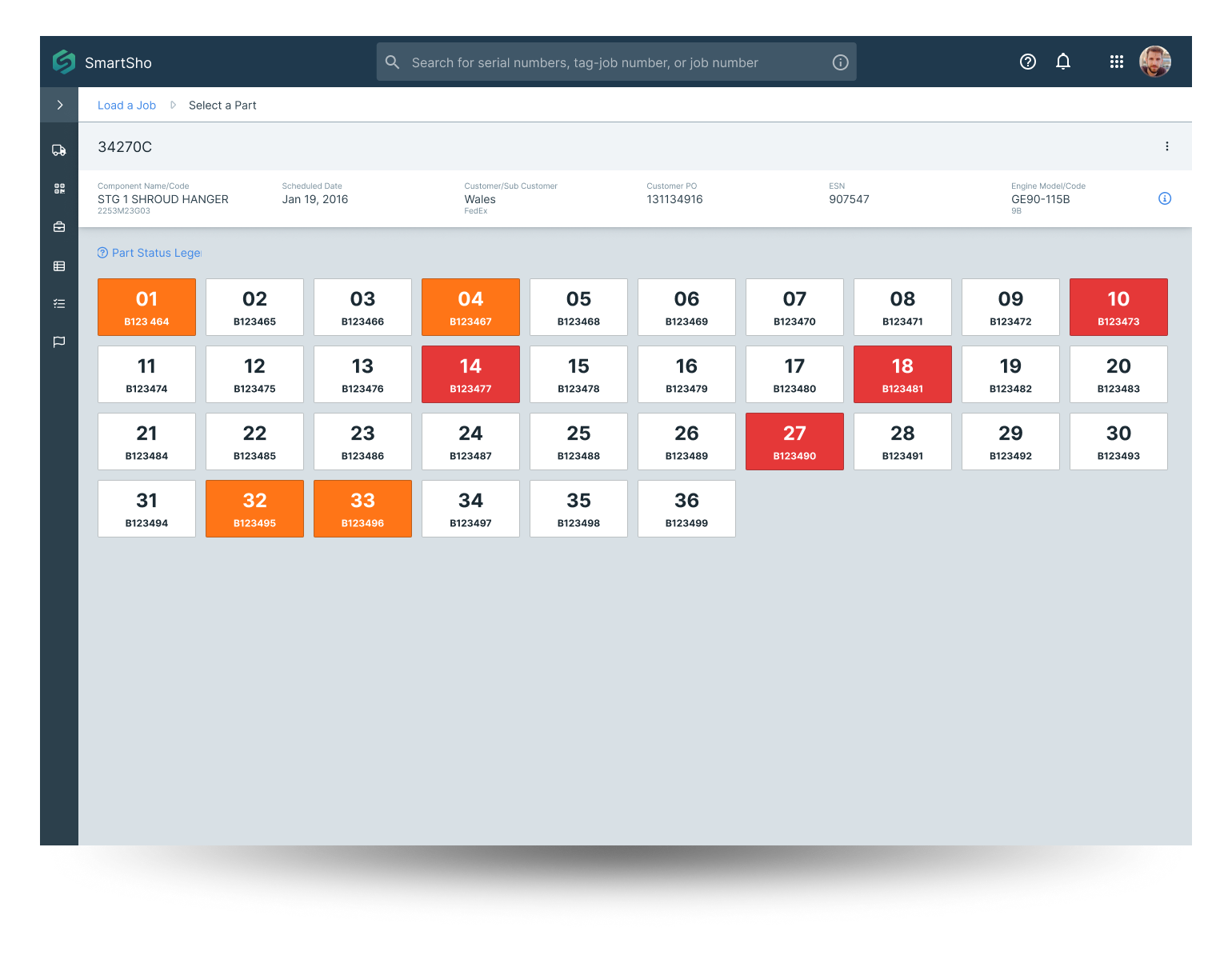
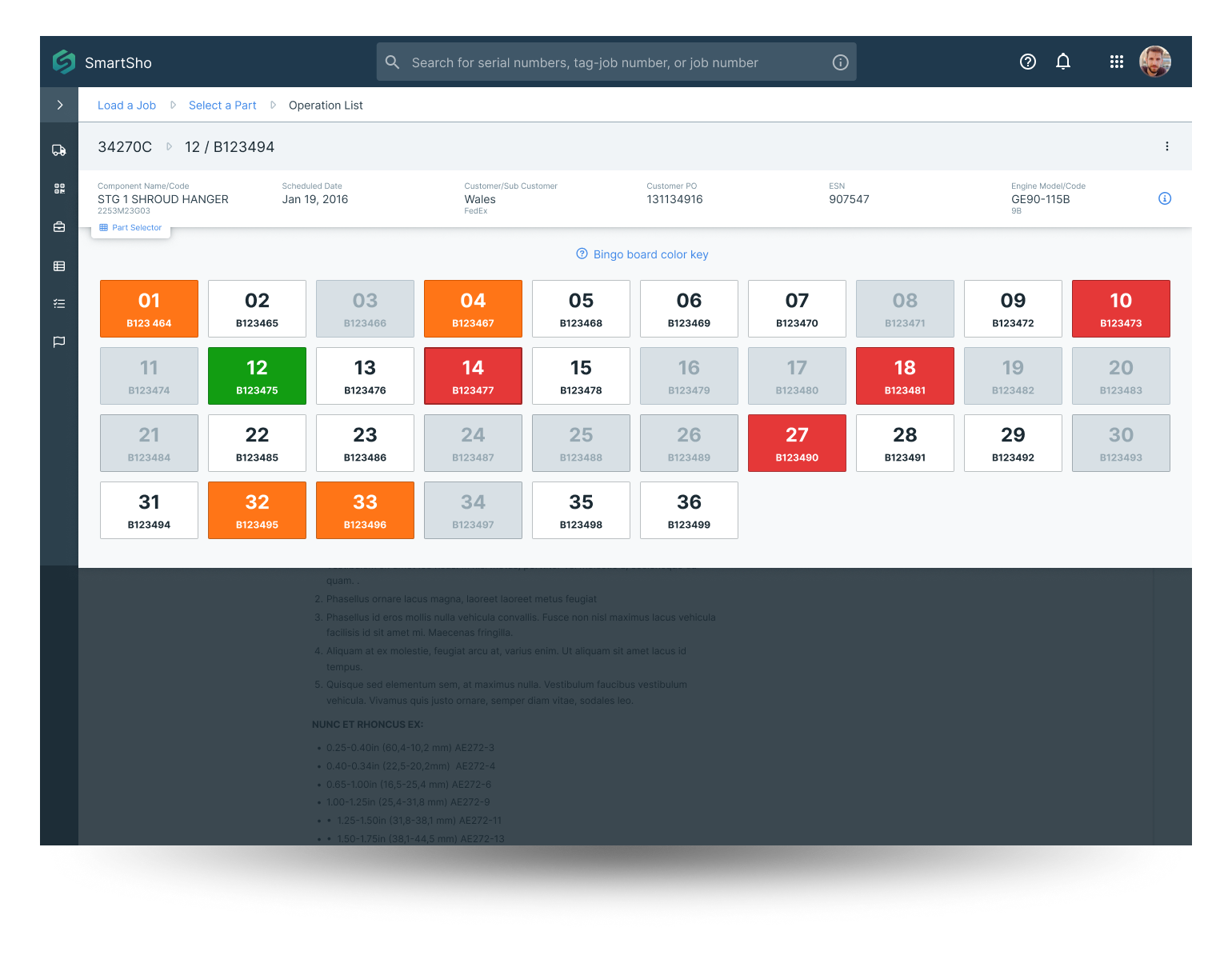
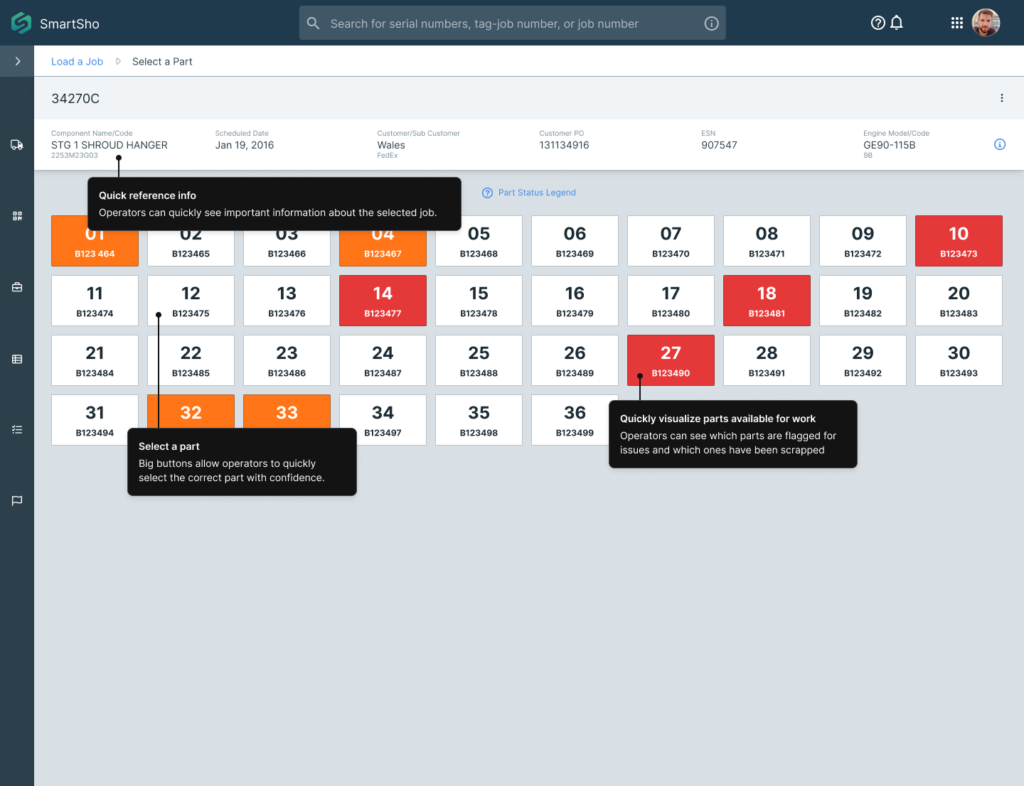
Underpinning all of it was the SmartShop design system — built from scratch in Sketch with a living style guide in Storybook, serving four engineering teams simultaneously. Beyond standard UI components, it included domain-specific patterns unique to shop floor repair: the bingo board, part cards, job headers, part detail headers, router operation lists, operation cards, and action cards. When team transitions happened, the design system was what made continuity possible.
Digital Execution — The Bingo Board
The impact
What Six Years Actually Produced
The numbers below come from the two initial pilot facilities — GE Aviation’s McAllen Component Repair Facility in Texas and GE Power’s GEMTEC facility in Saudi Arabia. These were early deployments. What they show is what the product could do before it had fully scaled.
80k+
Labor hours saved annually per facility
Work scoping dropped from 3 hours to 30 minutes per job at McAllen alone — 54,402 hours saved annually from that change. Final inspection, WIP tracking, and scope splits added tens of thousands more.
53%
Faster lead times at GEMTEC Saudi Arabia
Lead times in the P50 cell dropped 33 days. Labor hours per job fell by 10. Customer reporting increased from 2 to 6 reports per week — a 300% jump in transparency.
$1.6M
Reduction in work-in-progress capital
Real-time part visibility at GEMTEC cut WIP inventory by 50% — $1.6 million in capital freed from paper-driven delays.
1 → 7
Design team built from scratch
Started as a team of one. Left with a distributed team of seven designers across the US and Europe, a documented design system, and a research practice that could operate independently.
Still live
Still live in all GE Vernova Shops
When GE Aviation discontinued SmartShop after COVID, GE Power had already forked the codebase. That fork is still running at GE Vernova facilities around the world — the most durable measure of whether something was worth building.
GE Aviation discontinued SmartShop in 2020 due to COVID-related funding cuts — a business decision driven by circumstance, not product performance. GE Power had already forked the codebase and continued expanding independently. SmartShop is now running across GE Vernova’s global network of shops and cells. The cumulative impact of years of deployment across that network is significantly larger than what’s captured in these pilot numbers — though those results belong to GE Vernova to report, not me.